Anthropic's Agent Skills nears 200K stars; Claude Code's lead says prune old rules
Claude Code cut ~80% of its system prompt during model upgrades. Inside Anthropic's 3-layer stack, screen-recorded skills, and the ~6-month pruning bar.
By
Tenten AI Research Team
Applied AI
Published
Read time
14 min
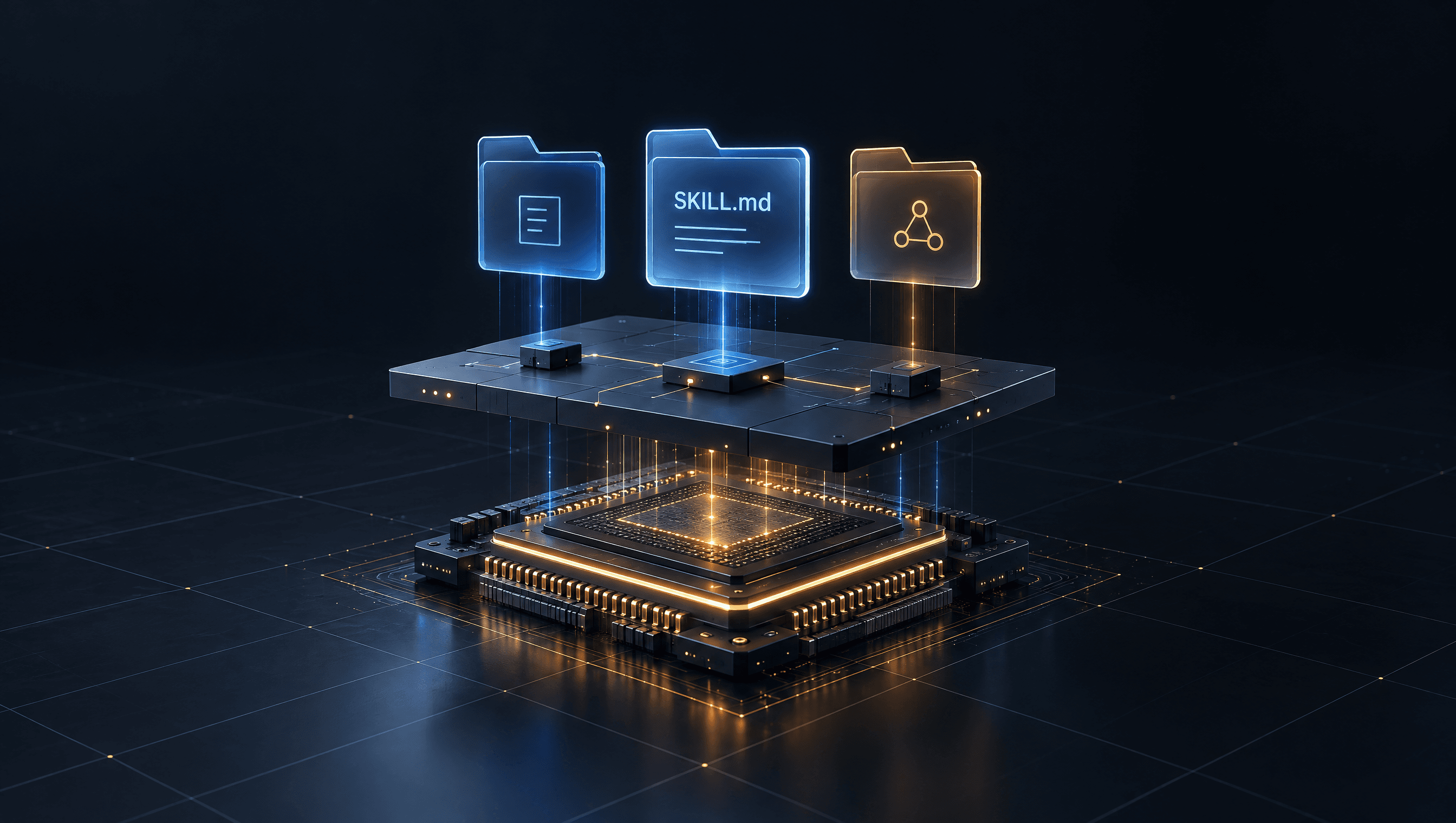
Anthropic's open-source Agent Skills repository (anthropics/skills) has reached 199,980 GitHub stars as of November 25, 2026. The Agent Skills approach pairs a foundation model and a general-purpose agent harness with portable SKILL.md directories loaded via three-tier progressive disclosure. Yet in an interview, Claude Code creator and technical lead Boris Cherny revealed that after an ablation study for newer frontier models such as Opus 5, his team cut roughly 80% of Claude Code's system prompt, and he advised developers to delete or test without their CLAUDE.md, skills, and hooks roughly every six months.
Those two facts look contradictory on the surface, but together they define the shift reshaping production AI engineering. Instead of spinning up dozens of fragile, single-purpose agents for every department, Anthropic's engineering guidance points to one general-purpose agent harness paired with portable SKILL.md folders, while Cherny's roughly six-month pruning advice helps prevent stale rules from holding back newer models or degrading output.
Treat the model as the chip, the harness as the OS, and Skills as apps
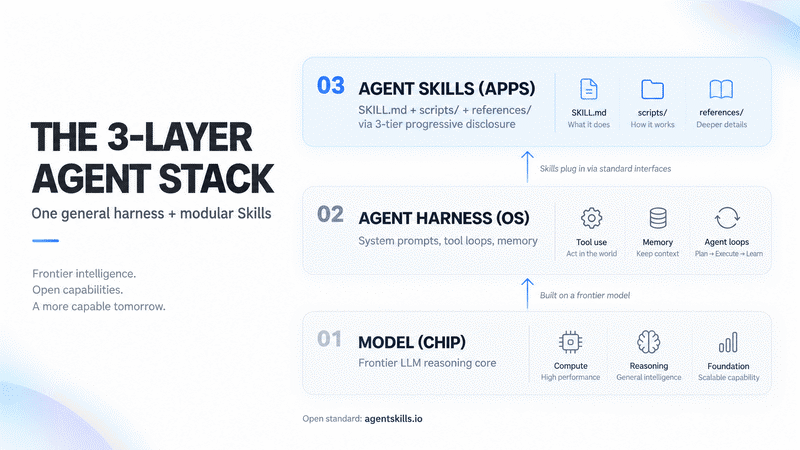
In their December 2025 AI Engineer talk Don't Build Agents, Build Skills Instead, Anthropic engineers Barry Zhang and Mahesh Murag frame the agent stack like computing layers. The foundation model acts like the processor chip, the agent harness (system prompts, tool loops, CLAUDE.md, and memory) acts like the operating system, and modular Skills sit on top as applications. You do not buy a new computer every time you need a new workflow; you install an app.
As Zhang summarized the team's internal discovery in the talk, the agent underneath is actually more universal than engineers initially assumed. In Anthropic's companion engineering post Equipping agents for the real world with Agent Skills, Zhang, Keith Lazuka, and Murag explain that general-purpose agents such as Claude Code can already accomplish complex tasks across domains using local code execution and filesystems. What they lack is procedural domain expertise, not another fragmented custom agent.
Under the Agent Skills specification, a Skill is deliberately minimal: a folder containing a required SKILL.md file (YAML frontmatter with name and description, followed by Markdown instructions) plus optional scripts/, references/, and assets/ directories. To keep context windows lean, agents use three-tier progressive disclosure. At startup, only each skill's lightweight name and description metadata loads into the system prompt. When a user request matches that description, the agent reads the full SKILL.md body. Linked reference documents or executable scripts load only if the active workflow calls for them. Because Anthropic published the format as an open standard at agentskills.io and donated it to the Linux Foundation's Agentic AI Foundation (AAIF), the same skill directory now travels across Claude Code, Claude, OpenAI Codex, Cursor, GitHub Copilot, and Gemini CLI without vendor lock-in.
Six levels of Agent Skills maturity, from screen recording to periodic deletion
Across Anthropic's tooling and team workflows, adopting and maintaining Agent Skills can be organized into six practical levels starting from manual authoring at Level 0. Moving across those stages shifts teams from writing static prompt instructions by hand to recording non-API interfaces, bundling executable scripts, sharing open-standard directories, and pruning stale rules when frontier models improve.
| Level | Practice | Where it pays off |
|---|---|---|
| Level 0–1 | Write SKILL.md manually or use official skill-creator | Interactive Q&A defines clear triggers and edge cases for first-time workflows |
| Level 2 | Do once, then Skillify (iterate with Claude) | Complete a task alongside Claude and capture successful approaches and common mistakes in a Skill |
| Level 3 | Screen recording (Record a skill) | Narrate UI clicks in legacy tools that have no API or MCP connector |
| Level 4 | Living context and executable scripts | Bundle brand rules, glossaries, reference files, and scripts (such as a Python PDF form parser) under references/, scripts/, and assets/ |
| Level 5 | Shared and borrowed open-standard skills | Version-control team skills in Git or adapt public libraries like anthropics/skills |
| Level 6 | Scheduled pruning for smarter models | Run frontier models periodically without legacy skills to remove obsolete guardrails |
For non-engineering teams, capturing a live workflow (Level 2) and recording screen actions (Level 3) remove the steepest authoring friction. Writing an airtight SOP from scratch is slow; Anthropic's engineering post recommends iterating directly with Claude on a real task and asking it to capture successful approaches and common mistakes into reusable context and code. For legacy vendor portals with no API or MCP support, Claude's custom skills documentation covers Record a skill in Claude Desktop's macOS Cowork mode (for paid Pro, Max, and Team plans, requiring Accessibility and Screen Recording permissions). Users click +, record their screen while narrating why they click each control, and let Claude compile a draft Skill. At Level 4, Anthropic's PDF skill example includes a pre-written Python script that reads a PDF and extracts form fields directly; running deterministic code for sorting, parsing, or form extraction and filling is cheaper and more reliable than token generation.
Why more Skills can actually make a smarter model worse
The strongest pushback from enterprise architects is straightforward: if progressive disclosure prevents context bloat and written Skills enforce repeatable compliance, why delete rules that took months to refine? That argument holds for immutable business rules, such as compliance checks, brand standards, or deterministic file parsers, but it breaks down for micromanaged reasoning steps.
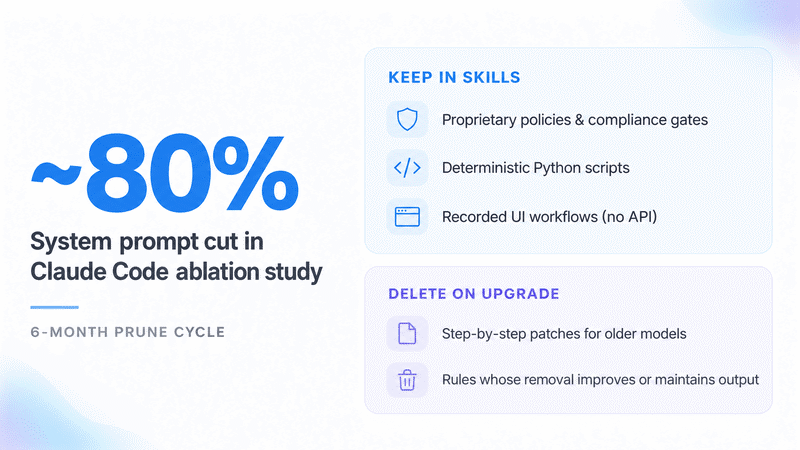
Cherny calls the failure mode "hobbling": overly prescriptive instructions written to patch weaknesses in older models actively get in the way of what newer models can solve natively. During Claude Code's ablation study for newer models, the team cut roughly 80% of the legacy system prompt because those older guardrails no longer helped and could degrade output.
Security introduces a second constraint. Anthropic's engineering post cautions that because Skills can bundle executable code alongside instructions inside an agent runtime, malicious or untrusted third-party skills can introduce vulnerabilities or direct an agent to exfiltrate data and take unintended actions. Copying external skills at Level 5 without thoroughly auditing bundled scripts/ and network calls trades short-term speed for production risk.
The architecture call: shrink the fleet and schedule a six-month purge
For engineering leads and founders still building separate agents for every internal workflow, the architectural call is clear: stop multiplying agent harnesses and consolidate around one core general agent plus a version-controlled Skills library.
Apply a concrete bar before writing a new Skill. If the current frontier model already solves the task natively on the first pass, do not codify step-by-step instructions. Package a Skill only when you need proprietary institutional context (pricing rules, glossaries, compliance gates), deterministic scripts, or recorded UI steps for non-API software. Then pair the Claude Code team's model-upgrade ablation practice with Cherny's personal advice to developers: roughly every six months, or on major model upgrades, run your core workflows with legacy skills disabled. Any rule whose removal leaves output unchanged, or improves it, belongs in the trash.
Sources
- Anthropic Engineering: Equipping agents for the real world with Agent Skills
- AI Engineer: Don't Build Agents, Build Skills Instead (Barry Zhang & Mahesh Murag, Anthropic)
- Agent Skills Open Standard Overview (agentskills.io)
- Agent Skills Format Specification (agentskills.io)
- GitHub: anthropics/skills Public Repository
- Claude Help Center: How to create custom skills
- Boris Cherny Interview on Claude Code, System Prompt Ablation, and Unhobbling
Summarize this page with AI
Related posts

Start with one workflow.
Agree on the next step.
Leave your contact details and question type. We will follow up by email to understand the work and discuss scope.