NGINX2Root covers five NGINX flaws. An automated scan found four of them.
NGINX2Root’s host-root demo relied on a separate Linux flaw. NGINX 1.30.7 and 1.31.9 fix the proxy bugs. Here’s how to verify deployment.
By
Tenten AI Research Team
Applied AI
Published
Read time
13 min

On November 18, 2026, NGINX released open-source versions 1.30.7 and 1.31.9 to patch five flaws that security researchers at Xint grouped under the name NGINX2Root. The HTTP/2 flaw CVE-2026-123007 can crash a traffic-handling worker or allow remote code execution under certain conditions. In its tests, Xint paired an NGINX flaw with a separate Linux kernel vulnerability and demonstrated both host root access and an escape from a Docker container. NGINX security advisories · Xint's NGINX2Root disclosure
Xint says one of its researchers found the main HTTP/2 bug. A few days later, its automated scan found four more. NGINX credits Albert of Vexera AI for CVE-2026-123633 and names both Xint and Maxim Dounin for CVE-2026-113425. For a company running NGINX across VM fleets, containers and managed gateways, the discovery story matters because the resulting work lands on all of those owners at once. We would put a defensive agent on the job of matching advisories to live assets and tracking the rollout through verification. Production changes still need a deployment system that can enforce policy and stop a bad rollout. Xint disclosure · NGINX 1.31.9 change log
One disclosure can give the proxy and kernel teams separate deadlines
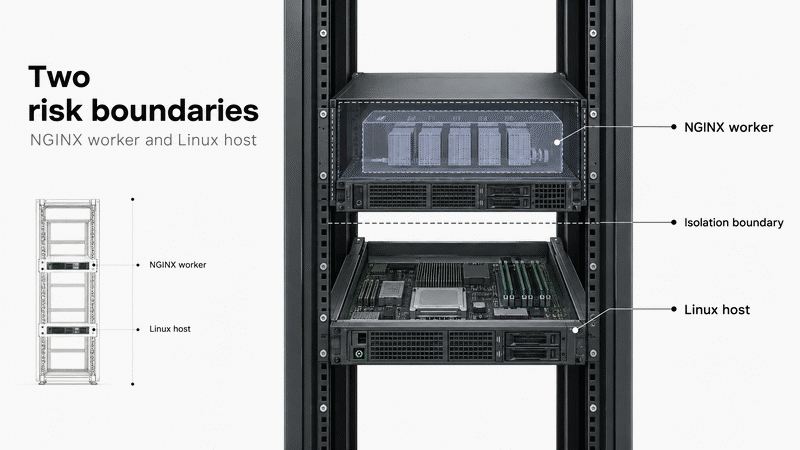
CVE-2026-123007 is a memory corruption issue in HTTP/2 flow control. The affected code handles traffic in the NGINX worker, before an application can apply its own account or API checks. F5 lists possible remote code execution when address space layout randomization (ASLR) is disabled or can be bypassed. Xint's host-root demonstration depended on a separate Linux kernel flaw in the test environment. In its November 18 disclosure, Xint said it would hold back most kernel details pending a fix. Fleet owners need to verify the NGINX fix across affected workers and track the kernel issue separately through their OS vendors. F5 advisory in the CVE record
| CVE | Affected area | What to inventory |
|---|---|---|
| CVE-2026-123007 | HTTP/2 flow control | HTTP/2 termination at the edge and origin |
| CVE-2026-123633 | HTTP/2 proxy worker memory safety | HTTP/2 proxies forwarding to backends and worker resource conditions |
| CVE-2026-121810 | HTTP/3 worker memory safety | Public listeners with HTTP/3 enabled |
| CVE-2026-123634 | Resolver and subrequests | Reverse proxies that resolve upstream names dynamically |
| CVE-2026-113425 | Mail proxy worker memory safety | NGINX mail proxy deployments |
The main HTTP/2 flaw spans upstream versions 1.9.5 through 1.31.8. Xint reported 56.7 million Shodan results on November 10. Only 11.94 million exposed an identifiable version, and 98.9% of that subset reported a version in the affected upstream range. The survey did not establish which hosts had HTTP/2 enabled or whether their distribution had backported a fix. Canonical published an Ubuntu package advisory on November 19. For distribution packages, match the actual package revision to the relevant advisory. Xint disclosure · Canonical’s NGINX package advisory
For an organization that cannot deploy a fixed package immediately, disabling HTTP/2 where the affected code is reachable can reduce exposure to the two HTTP/2 issues. The service owner should check clients and dependencies such as gRPC before changing a listener. HTTP/3, resolver and mail proxy exposure require their own assessment. A firewall can restrict who gets to a listener, a WAF can buy time for traffic it can inspect, and endpoint tools can alert on unusual process behavior. Operational teams still need to establish where protocol handling takes place and which running binary handles it.
OpenSSH says it will ship fixes more often
PHP released fixes for the two unauthenticated PHP2Shell vulnerabilities on October 21. Cloudflare says it deployed protective rules before the release and saw attack traffic. OpenSSH released 10.6p2 on November 5 and said it had received many security reports recently, including AI-generated and AI-assisted findings. Some had no security impact under realistic threat models, and some bugs were rediscovered independently. The maintainers said they would ship fixes more often for now. NGINX followed on November 18, 28 days after the PHP release. Its mainline change log lists ten security fixes, including the five in the NGINX2Root group. On November 19, Canonical also published a multi-issue Linux kernel advisory for Ubuntu 24.04 LTS on Azure. That advisory is a separate example of kernel maintenance. Track the Xint kernel issue through OS vendor notices. PHP security release · Cloudflare's PHP2Shell account · OpenSSH 10.6p2 release notes · Canonical’s Azure kernel advisory
These releases put overlapping demands on operations teams. The OpenSSH notice describes what happens upstream. Maintainers have more reports to screen for real impact. Some of the valid bugs can be independently found again soon enough that holding a fix for the next scheduled release carries more risk. On the receiving end, a monthly review can leave a patch sitting in a vendor repository while exposed services keep using the affected build.
An agent can own the evidence while the release system controls the change
An agent can read vendor advisories and distribution notices, resolve them against a fleet inventory and produce an assigned ticket with evidence for each exposed service. Have it start with read-only access to actual package revisions, image digests, enabled protocols, ingress paths and service ownership. Incomplete inventory should generate a verification task. For prioritization, combine exposure and business impact with exploitation evidence such as CISA's Known Exploited Vulnerabilities catalog. A version banner and a severity score are too thin a basis for a production change. CISA's Known Exploited Vulnerabilities catalog
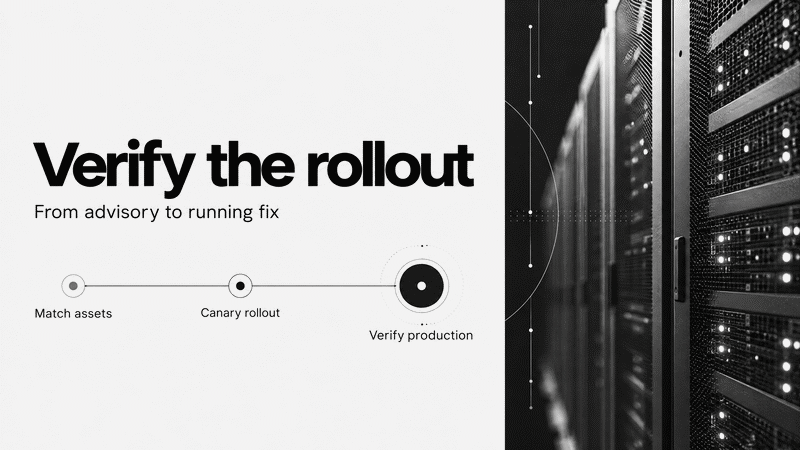
Keep release authority in the existing deployment system. It can issue short-lived, narrowly scoped permissions for preapproved changes and require a service owner's approval for kernel reboots, traffic shifts or coordinated fleet updates. Patch a small group first and check service errors, health checks and connection behavior before expanding. If a check fails, halt the rollout and use the approved recovery path. Treat advisories and logs as input data, with permitted actions and trusted package sources enforced by the release system.
Set the ticket's closure condition to a fixed build serving real traffic. A new container image in a registry tells you that the artifact exists. Confirm the rollout replaced the old workloads. An installed kernel package tells you what is on the disk. Confirm the running kernel after reboot. If there are signs of earlier compromise, open a separate incident with evidence preservation, isolation and credential rotation where warranted. NIST's patch management guidance includes verification for the same reason that the version running in production belongs in the change record. NIST SP 800-40 Rev. 4
For an internet-facing service with redundant capacity, we would start with a four-hour target to decide exposure and a same-day target for a first verified rollout or a temporary mitigation. Measure the 95th percentile on each stage and count assets that are still awaiting verification after the deadline. If the agent takes twenty minutes to produce a sound exposure assessment and the rollout waits two days for a maintenance window, the next investment belongs in the release process.
Sources
- NGINX security advisories
- NGINX mainline 1.31.9 release history
- NGINX stable 1.30.7 release history
- Xint's NGINX2Root public disclosure
- CVE-2026-123007 record by F5
- PHP's security releases
- Cloudflare's account of PHP2Shell protection
- OpenSSH 10.6p2 release notes
- CISA's Known Exploited Vulnerabilities catalog
- Canonical’s NGINX package advisory USN-9159-1
- Canonical’s Azure kernel advisory USN-9160-1
- NIST guide to enterprise patch management
Summarize this page with AI
Related posts

Start with one workflow.
Agree on the next step.
Leave your contact details and question type. We will follow up by email to understand the work and discuss scope.