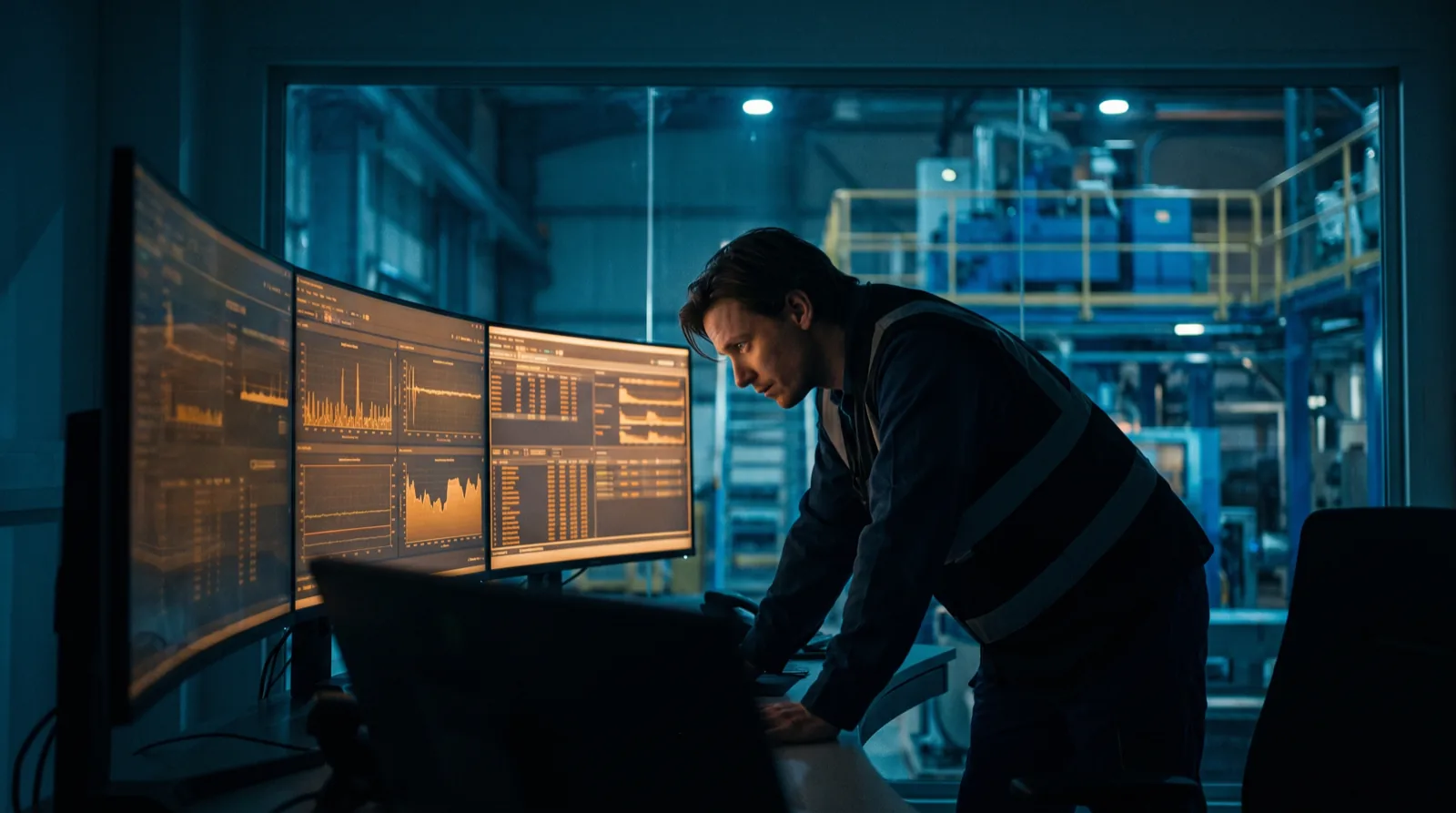
SOLUTION · MANUFACTURING

AI Solutions for Manufacturing

Catch defects before they leave the line. Visual inspection deployed in weeks, edge inference that runs offline, and a process you can copy to every line. Engineers embed on your factory floor to build it.

AI Solutions for Manufacturing

Weeks

to first line live, not months

Offline

edge inference, runs without network

MES/PLC

native integration, no control-logic changes

Push quality inspection past the limits of the human eye, at line speed

Most quality problems on a factory floor aren't caused by 'no one checking'. They happen because human inspection can't keep up at production speed. Standards drift between shifts, fatigue lets defects slip through, and customer returns trace back to a root cause no one can pin down. Adding inspectors fixes none of it. Off-the-shelf AI vision tools assume you have a reliable network, clean labeled data, and a line you can stop whenever you want to tune. Almost none of that is true on a real floor.

Our approach is to put engineers on-site. We capture images and train models on your actual lighting, your actual fixtures, and your actual reject samples, then run inference on an edge device right next to the line. No external connectivity. No images leaving the building. When the plant loses its network, inspection keeps running. Results drive your existing PLC I/O and MES integration to trigger rejects or log records, without touching your line control logic.

What we deliver isn't a demo rig. It's a process you can reproduce. Once the first line is validated, the model, labeling spec, and deployment scripts move to the second line and the third, so your quality lead walks into an audit or a customer complaint with judgments that are consistent and easy to explain.

How it works

Catch defects before they leave the line. Visual inspection deployed in weeks, edge inference that runs offline, and a process you can copy to every line. Engineers embed on your factory floor to build it.

Inspection pipeline

Line image capture
Edge vision model
Defect classification
MES / PLC signal

Decision

Classified part
Pass → continue lineSuspect → operator review

Capabilities

Line-speed visual defect inspection

Models trained on your real line lighting and takt time make real-time calls on scratches, burrs, wrong parts, missing parts, solder joints, and surface flaws, with adjustable thresholds so quality can tighten or loosen by customer spec.

Edge deployment that runs offline

Inference runs on an edge device next to the line (including NVIDIA Jetson-class hardware) with no dependence on external network. Inspection keeps working when the plant drops connectivity, and images and results can be kept entirely on-premise to meet security and trade-secret requirements.

Native MES / PLC integration

We trigger reject signals and write inspection records through PLC I/O, OPC UA, or your existing MES API, without changing your line control logic, so AI judgments slot into your current process flow.

Controlled false-reject and escape rates

We tune against the escape rate you're willing to accept as a hard target, and hand you confusion matrices and threshold curves so you can make a defensible tradeoff between false rejects and escapes by product and customer requirement.

Equipment maintenance knowledge base

We turn repair knowledge scattered across SOPs, machine manuals, maintenance logs, and your senior technicians' heads into a searchable knowledge base, so floor staff can ask 'how do I clear this alarm code' in plain language and get an answer with cited sources.

Scheduling and dispatch assistance

On top of your existing ERP/MES data, we model and recommend options for changeovers, rush-order insertions, and labor allocation, turning decisions that used to ride on a senior scheduler's gut into plans you can review and repeat.

Delivery cadence

  1. 01

    WEEK 1

    On-site survey and data capture

    Engineers embed on your line, lock down lighting, fixtures, and camera mounting, collect real good and NG samples, and confirm MES/PLC integration points and the acceptable escape ceiling.

  2. 02

    WEEK 2–3

    Model training and single-line validation

    We train and tune on real data, deploy to the edge device beside the line, wire up PLC/MES triggering and logging, and prove it out on one line with judgment standards aligned.

  3. 03

    WEEK 4

    Trial run and threshold calibration

    We benchmark against human inspection on live output, calibrate false rejects and escapes, lock thresholds, and complete operating and maintenance handover docs for your quality team to run day-to-day.

  4. 04

    WEEK 5+

    Cross-line replication and scale-up

    We copy the validated model, labeling spec, and deployment scripts to other lines and plants, expanding inspection coverage and standing up model retraining and monitoring.

Use cases

01

Surface-defect inspection on metal stampings

Industrial cameras at the press outlet make real-time calls on scratches, dents, and burrs; NG parts are kicked out by a PLC-triggered air ejector, replacing sample-check escapes and downstream complaints.

02

PCB / SMT solder-joint and wrong-part inspection

Visual inspection added after placement and reflow catches open joints, wrong parts, reversed polarity, and missing components, covering the cosmetic defects rule-based AOI struggles with and cutting board-level rework.

03

Label and seal inspection on packaging lines

Detect crooked labels, blurred printing, wrong lot codes, and bad seals, catching them before shipment to avoid full-batch returns and downstream channel penalties.

04

Rapid troubleshooting from machine alarms

Floor technicians ask the maintenance knowledge base about an alarm code or fault symptom and get step-by-step remediation with citations to the manual and past work orders, cutting downtime.

05

Changeover scheduling for rush orders

When sales drops in a rush order, the scheduling assistant models several changeover options against current WIP, tooling, and labor, flags the delivery-date impact, and lets the scheduler decide fast.

FAQ

Yes. Inference runs entirely on an edge device next to the line with no dependence on external connectivity, so inspection keeps working when the plant loses its network. Images and results can be configured to never leave the building, processed and stored locally only, to meet security and trade-secret requirements.

We tune against the escape ceiling you're willing to accept as a hard target and calibrate thresholds on real production data to keep false rejects in an acceptable range. Thresholds stay adjustable, so quality can make a defensible tradeoff between false rejects and escapes per product and customer spec, rather than accepting a fixed black-box call.

We trigger reject signals and write inspection records through PLC I/O, OPC UA, or your existing MES API, without changing your line control logic. We confirm the integration points with your automation and IT teams on-site during the first week so AI judgments slot cleanly into your current process.

Because our engineers embed on-site, capturing data and training on your actual lighting, fixtures, and NG samples, with no back-and-forth or remote guesswork. The first line is typically live for validation within weeks. The slower work of cross-line scale-up builds on a process that's already proven, so replication cost drops sharply.

Most factories start without clean labeled data, and that's normal. We help collect and label real NG samples on-site, use model strategies suited to limited data to get the first line working, and then keep improving accuracy as samples accumulate in production.

Yes. That's the core of what we deliver. Once the first line is validated, the model, labeling spec, and deployment scripts are portable, so replicating to a second line, a third line, or another plant doesn't start from scratch each time. Judgment standards stay consistent, which also makes audits and complaint follow-up far easier.

AI workflows,
built into your operations

We deploy forward — FDE and FDM — to build the AI agents and workflows your team runs on. Live in weeks, not quarters.