Google's new mid-tier Gemini 4 Neon edges past flagship Carbon at $3 input and $15 output
Google's Gemini 4 Neon scores 61 at xhigh thinking—one point above Carbon—while running faster and 32% cheaper per task at default high, though Carbon's $2/$10 promo runs through November 30.
By
Tenten AI Delivery Team
Industry Delivery
Published
Read time
12 min
Google introduced Gemini 4 Neon on November 18, 2026, slotting a fast, high-judgment model between its flagship Gemini 4 Carbon and lightweight Gemini 4 Hydrogen. Priced at $3 per million input tokens ($0.15 per million cached input tokens, a 95% discount) and $15 per million output tokens across a flat 1 million-token context window, Neon scores 61 on the Artificial Analysis Intelligence Index at its xhigh thinking level, ranking #3 overall and edging one point past Carbon's 60.
For engineering leaders and enterprise AI buyers trying to rein in agentic inference bills, Gemini 4 Neon challenges the assumption that complex multi-step workflows require flagship pricing. Announced by Google DeepMind SVP and Google Chief AI Architect Koray Kavukcuoglu, Neon rolls out across the paid Gemini API in Google AI Studio, Android Studio, Gemini for business, Google Antigravity for paid Google AI Pro and Ultra subscribers, and the Gemini app for Pro and Ultra users.
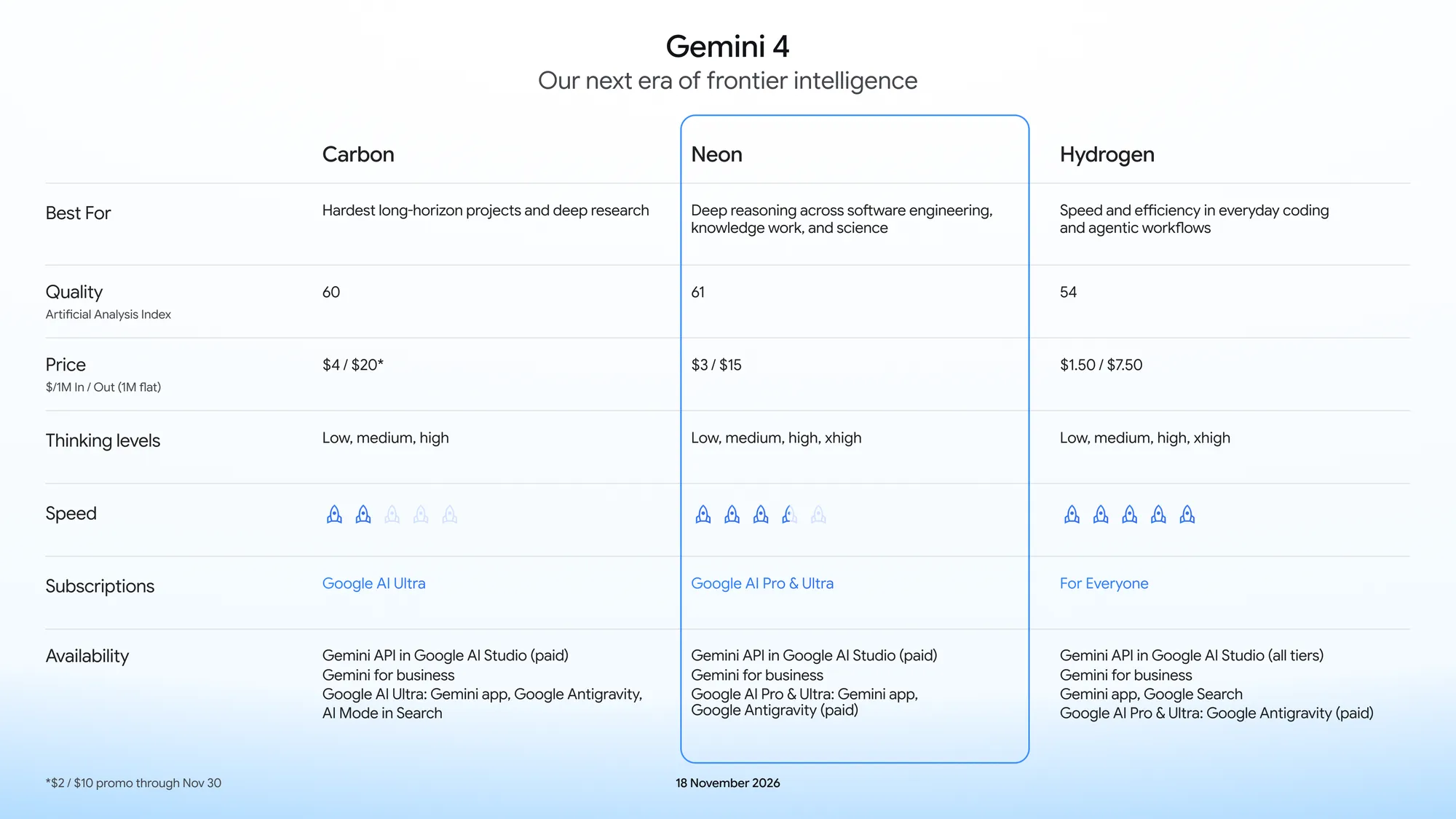
Four thinking tiers cut task costs 32%, with one November 30 pricing catch
Gemini 4 Neon ships with four configurable thinking levels (low, medium, high as default, and xhigh), allowing teams to dial reasoning depth per workload instead of paying a fixed compute tax. On the Artificial Analysis Intelligence Index at its default high setting, Google reports that Neon delivers a 32% lower cost per task than Gemini 4 Carbon. On both the Vals Index and Agent Arena at high, Neon lands on the Pareto frontier at roughly 50% to 80% lower cost per task than top competing frontier models. Even at xhigh, Google says Neon achieves its top intelligence score while costing 36% or more less per task than competing models at their highest setting.
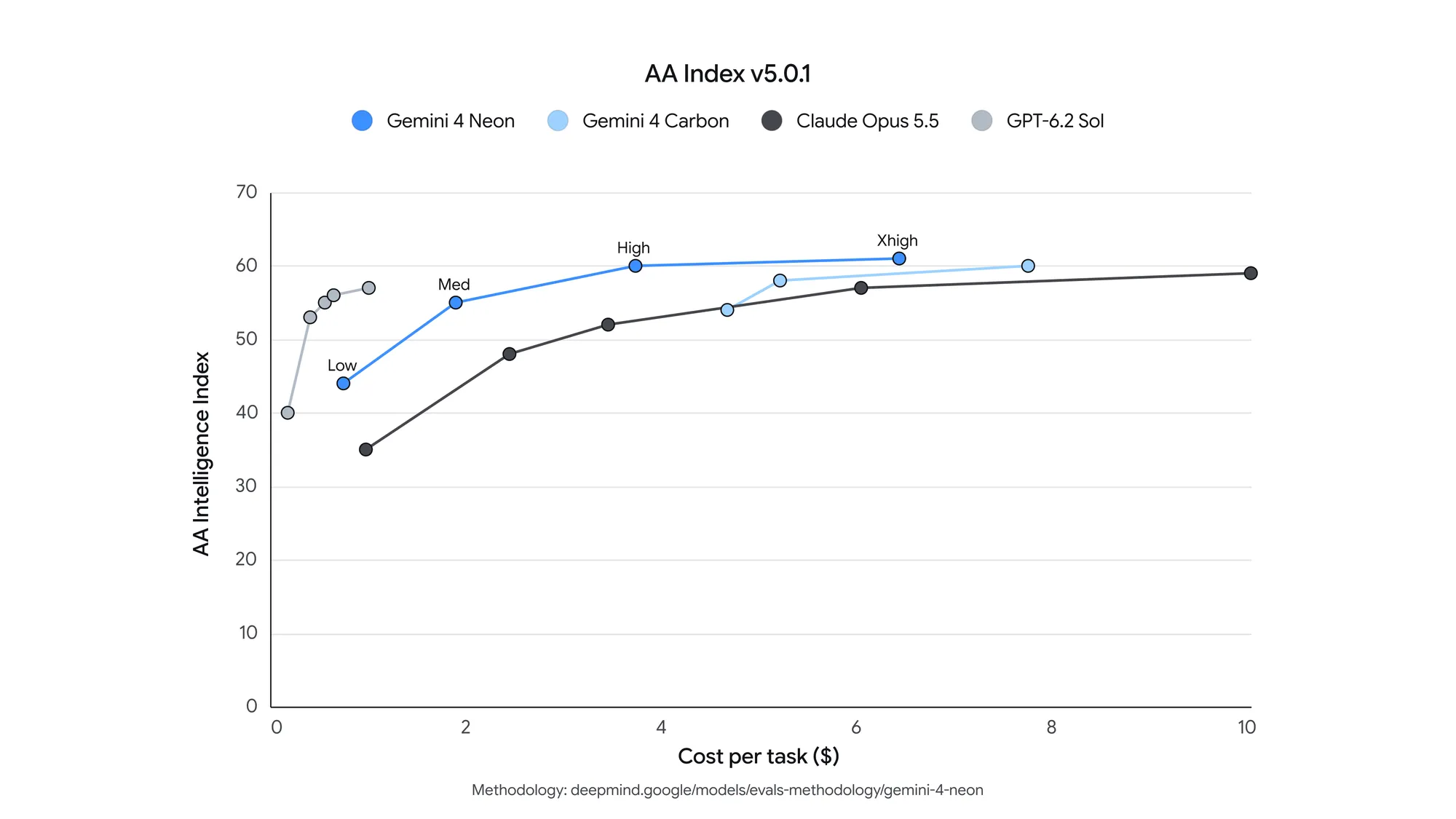
One near-term pricing nuance matters for budget planning right now. While Gemini 4 Carbon's standard list price is $4 input and $20 output per million tokens, Google's official family chart notes that Carbon's $2/$10 promotional pricing runs through November 30, 2026. Until that promotion expires, Carbon carries a lower raw token price than Neon's $3/$15 list rate, even though Neon runs faster (rated 4 of 5 speed rockets versus Carbon's 2 of 5) and delivers lower per-task spend once Carbon reverts to standard pricing in December.
Coding agents, enterprise knowledge work, and cyber defense lead the benchmark sheet
In software engineering evaluations, Gemini 4 Neon takes #1 overall on the Artificial Analysis Coding Agent Index with a score of 58.6. On repository-level coding, Neon posts 65.4% on CursorBench 4.1 (ahead of Claude Opus 5.5 at 58.1%), 65.2% cheating-adjusted accuracy on Terminal-Bench 4.1 (versus 65.8% for Opus 5.5 and 61.5% for GPT-6.2 Sol), and 46.2% at default high on FrontierCode 2.0. On SWE-sweep, Neon leads at 12.8% on the mini-SWE harness and jumps to 39.0% inside Google Antigravity, compared with 10.1% for Opus 5.5 and 8.3% for GPT-6.2 Sol on provider harnesses.
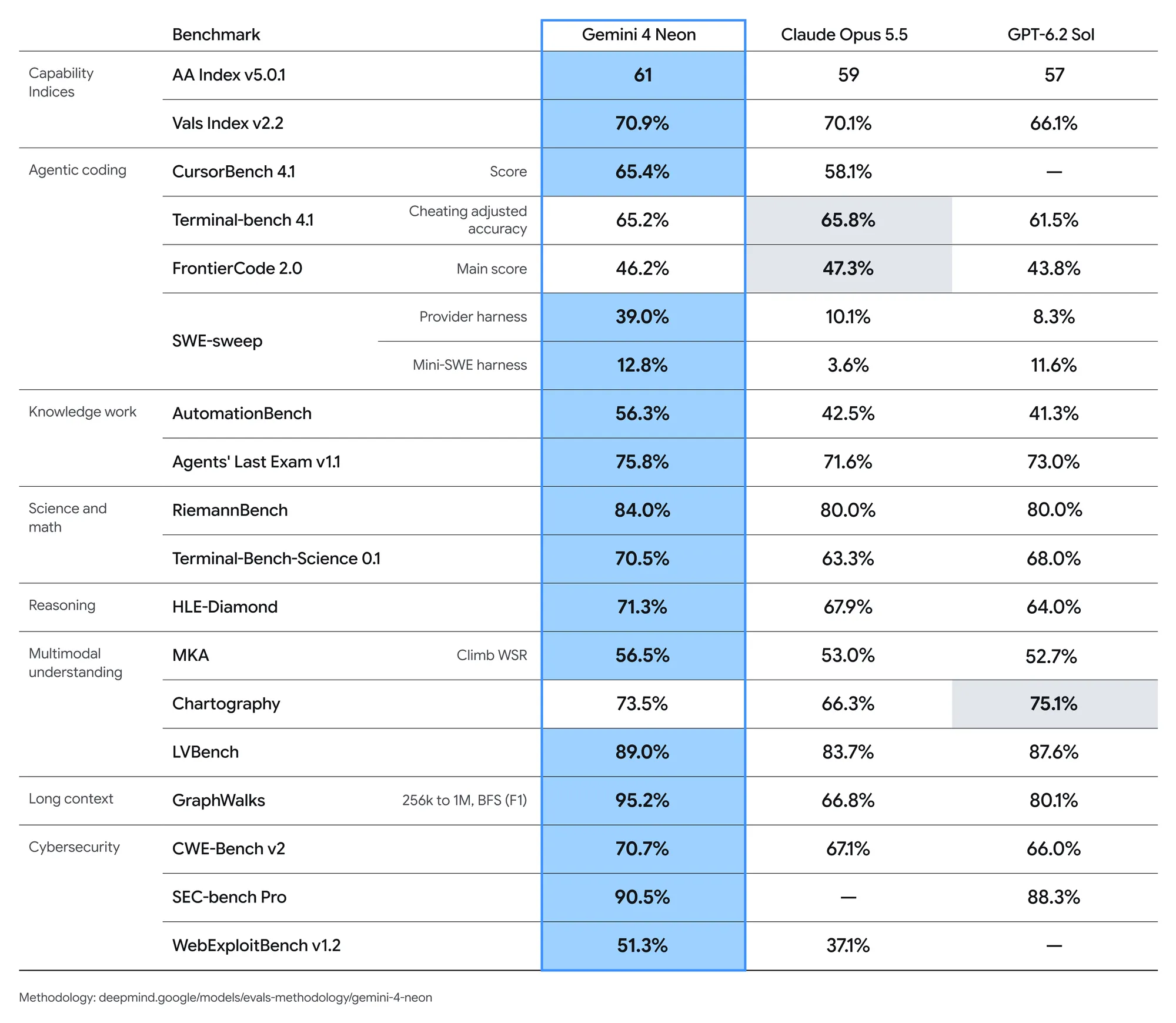
Across enterprise and scientific workloads, Gemini 4 Neon ranks #2 on the Vals Index v2.2 at 70.9% (versus 70.1% for Opus 5.5 and 66.1% for GPT-6.2 Sol) and takes #1 on both Legal Research Bench and Tax Agent Bench. It also ranks #1 overall on Zapier's AutomationBench (56.3%) and Andon Labs' Vending-Bench 2 ($16,843), while debuting #2 globally on Arena's Agent Arena Index with a score of 1336 across more than 4,200 real-world agent sessions (and #2 on mid-task steerability). On long-context retrieval, Neon scores 95.2% on GraphWalks (256k to 1M tokens), outpacing Opus 5.5 (66.8%) and GPT-6.2 Sol (80.1%), alongside top marks in Terminal-Bench-Science 0.1 (70.5%), RiemannBench (84.0%), and HLE-Diamond (71.3%).
Google also highlighted a cyber-defense release rolling out to eligible defenders through the Fairwind Program. Neon reaches 76% on AutoBaxBench hard challenges and 51.26% on WebExploitBench v1.2 (rounded to 51.3% in the summary table) at half the cost of competing large models. It also scores 90.5% on SEC-bench Pro at roughly half the cost per challenge, reaches 70.7% on Collinear's CWE-bench v2 (a 3.4% gain over Carbon), and matches frontier results on ExploitGym with half the tokens of Carbon. On safety and alignment, Google reports a 0.0% attack success rate on Gray Swan's indirect prompt injection benchmark at highest thinking with real-time safeguards and 0.0% cheating on Terminal-Bench 4.0. The company also reports a 1.98% refusal rate on legitimate Terminal-Bench 4.0 tasks (0% on Terminal-Bench-Science), a 0.09% misaligned action rate, and a 99.2% pass rate on its agent honesty evaluation.
Where Gemini 4 Neon fits in a production multi-model stack
Google's Gemini 4 lineup now separates cleanly by workload economics: Carbon ($4/$20 standard) for the hardest long-horizon research, Hydrogen ($1.50/$7.50) for high-volume everyday execution, and Neon ($3/$15) for complex coding, analytical workflows, and multi-agent orchestration. In Google Antigravity, Google specifically positions Neon to run standalone or act as a fast Orchestrator directing parallel Hydrogen subagents.
For teams building production AI pipelines, the routing call is straightforward. Keep latency-tolerant deep-research jobs on Carbon while its $2/$10 promotion lasts through November 30; once December list pricing returns, or whenever workflows depend on fast tool loops, 1M-token retrieval accuracy, and controllable thinking budgets, Gemini 4 Neon becomes the default workhorse tier.
Sources
Summarize this page with AI
Related posts

Start with one workflow.
Agree on the next step.
Leave your contact details and question type. We will follow up by email to understand the work and discuss scope.